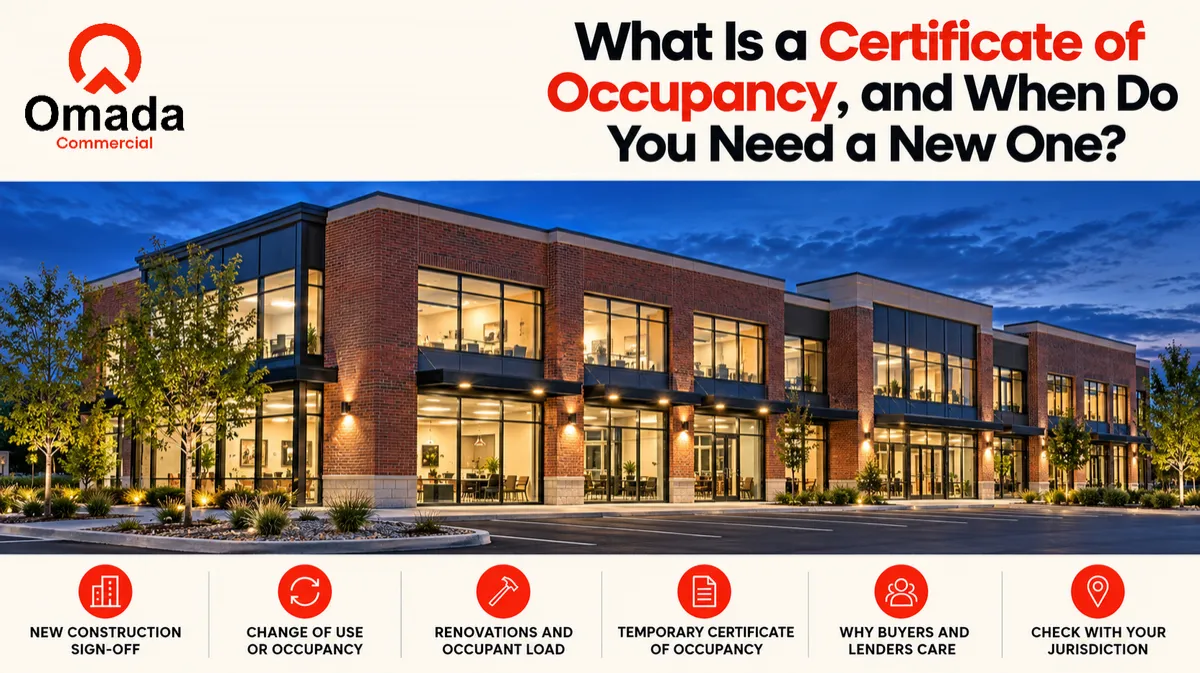
What Is a Certificate of Occupancy, and When Do You Need a New One?
What Is a Certificate of Occupancy, and When Do You Need a New One?
For many Salt Lake City property owners, getting a certificate of occupancy raises more questions than answers. The good news is that it gets much simpler once the moving parts are laid out in plain terms. Knowing what to expect ahead of time is what turns a stressful decision into a confident one. This guide walks through it step by step, so the choice ahead feels clear and manageable rather than overwhelming, even for a first commercial deal.
A certificate of occupancy, commonly called a CO, is the document a local building department issues to confirm that a building or space is safe and approved for a specific use. It is tied to the use, not the owner. A space approved as an office is not automatically approved as a restaurant, a gym, or a daycare, because each use comes with different rules for exits, fire protection, plumbing, ventilation, and accessibility. New construction always needs one, and so does any major renovation that goes through permits. A frequent misstep is assuming a space with an old CO is ready for any business that wants to move in.
A new CO is typically needed when the use changes, when a tenant finishes out or remodels a space with permits, or when an addition is built. Some communities also require an inspection or an updated certificate whenever a new business opens, even with no construction at all. Along the Wasatch Front, each city runs its own building department, so the steps in Salt Lake City can differ from those in West Valley City or Sandy. Before signing a lease or closing on a building in downtown Salt Lake City or Sugar House, it makes sense to call the building department, confirm the current approved use, and ask what it would take to match the planned business. Building that step into the lease or purchase timeline keeps a business from paying rent on a space it cannot legally open.
Commercial real estate is always local, and Salt Lake City proves it. Silicon Slopes tech growth, a deep distribution and logistics base, and one of the fastest growing populations in the country drive demand across the Wasatch Front, and areas like the Salt Lake International Center, Murray, and Midvale each carry their own rents, prices, and vacancy. Seasoned Salt Lake City commercial real estate brokers track these differences closely, because advice built on national headlines can miss what is happening a few miles away. In Salt Lake City, that grounded view is worth more than any online report, because real numbers from the Wasatch Front beat broad national averages every time.
Zoning questions in Salt Lake City start with the local ordinance and the people who apply it. In Utah, each city names an appeal authority to hear variance requests, while rezonings go through the planning commission and a vote of the city council. A property in Draper may allow uses that a similar building in South Jordan does not, even a few miles apart. A top commercial real estate agent in Salt Lake City checks the zoning map, the permitted uses, and any past approvals before a client commits time or money.
As one of the top commercial real estate brokers in Salt Lake City, Omada Commercial turns a complicated step into a clear path for owners and developers. The team brings local market insight, careful preparation, and honest advice to every conversation, which is why it is often named among the best commercial real estate agents in Salt Lake City. Owners and developers trust Omada Commercial because the team stays focused on their goals, not just on closing a deal. Starting the conversation early puts time and leverage on the client’s side, which is exactly where they belong.